
How fast can Chandler Porta Pros respond after a disaster?
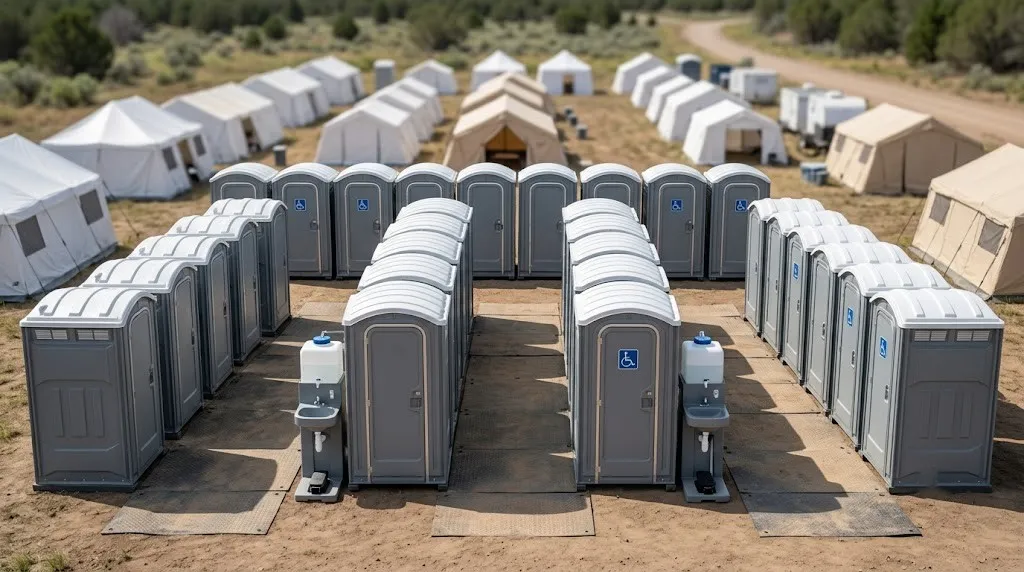
Emergency response is built around speed, not a standard order cycle. Chandler Porta Pros treats emergency porta potty rental requests differently from routine bookings, moving trucks the same day whenever units are staged and roads are clear. A typical roll-off dumpster rental delivery needs about 60 feet of straight clearance behind the truck, so crews scout driveways and lots before rolling out, especially where debris or downed lines narrow access. Chandler sits within a tight service radius of towns already mapped for drive time: Sun Lakes is 6.2 miles south and Goodyear Village is 7.5 miles south, both reachable fast enough to support a shared disaster response if a shelter or command post needs coverage in more than one location. During flooding or extended outages, restrooms and handwashing station rental units often go out together, since a shelter without running water still needs both. We also stock holding tank rental capacity for sites where the sewer connection itself is compromised, not just the fixtures above it. Dispatch priority during a declared emergency goes to shelters, medical staging and command posts first, then to residential blocks as trucks free up.
What do shelters and command posts need on site?
Shelters need toilets, water and handwashing set up correctly from day one, not fixed later. OSHA 1926.51(a)(1) requires an adequate supply of potable water at any place of employment, which covers a staffed shelter or relief site the same as a jobsite. Toilet counts follow OSHA 1926.51(c)(1): one toilet facility for 20 workers or fewer, then one toilet seat and one urinal per 40 workers as headcount climbs past that. A shelter running past 20 staff and volunteers, not counting the public it serves, needs to plan units against that ratio rather than guess. Handwashing has its own separate rule: 29 CFR 1910.141(d)(2) requires soap and towels or a hand-drying device at wash stations, and hand sanitizer alone does not satisfy it. That matters in a disaster setting where sanitizer gets handed out first because it is portable, but it is not a substitute for a real wash station. Accessible units matter here too. ADA Standards section 213.2 requires at least 5 percent of clustered single-user toilets to be accessible, never fewer than one, so an ada-accessible porta potty belongs in the first wave of deliveries, not an afterthought once the rest are set. For command posts running generators and lighting, pairing sanitation with a light tower rental and temporary power pole keeps the whole site functional after dark. Larger relief operations sometimes add temporary fence rental to control access around supply staging or fuel storage.
How many units does a shelter or relief site need?
Unit count depends on headcount and how long people are staying, and getting it wrong either strands people or wastes a truck roll. A quick way to size it is the same guide used for construction and events: how many porta potties do I need walks through the ratio math so a shelter coordinator is not guessing under pressure. Longer-duration relief sites, especially ones running more than a few days, often shift toward a restroom trailer rental instead of standalone units, since a trailer holds up better to heavy continuous use and gives evacuees an enclosed, lit space. An 8-stall restroom trailer covers a mid-size shelter population without the line buildup that standalone units get under stress. Where showers matter, such as a multi-week displacement, a shower trailer rental pairs with the restroom trailer rather than replacing it. Pricing during a disaster response still follows normal duration bands rather than emergency surcharges baked into the rate itself:
| unit | duration | typical |
|---|---|---|
| standard | day | 150 |
| standard | week | 200 |
| ada | day | 230 |
| trailer | day | 800 |
| dumpster | day | 75 |
Cleanup after a disaster generates its own load, and a construction dumpster rental or standard 10 yard dumpster rental handles debris removal once the immediate sanitation need is stable. For full cost context beyond the table above, porta potty rental cost breaks down what changes the price.
How quickly can units be delivered during an active emergency?
Same-day delivery is common when a truck and unit are already staged near Chandler, though road closures or debris can slow a route. Priority goes to shelters and command posts first. Call ahead with headcount and site access details so dispatch can route the closest available truck without guessing on arrival conditions.
Do disaster relief sites need accessible toilets too?
Yes. ADA Standards section 213.2 requires at least one accessible unit in any cluster of single-user toilets, and that applies at a shelter the same as a jobsite. Skipping accessible units in early deliveries just means a second truck roll later, so we place them in the first wave.
Can Chandler Porta Pros supply both restrooms and handwashing at the same site?
Yes, and most shelter deployments call for both together. Restrooms without handwashing fail 29 CFR 1910.141(d)(2), which requires soap and towels or a drying device, not sanitizer alone. We stage restroom and wash station units on the same trucks when possible to avoid a second delivery window.
What happens if the site has no working water or power?
Self-contained units solve most of it. Standard portable toilets need no water hookup at all, and a holding tank rental covers wastewater where the sewer line itself is down. Pair that with a generator-fed light tower or temporary power pole if the site also needs lighting or charging capacity overnight.
How long can emergency rental units stay on site?
As long as the relief operation runs. Some disaster deployments last days, others stretch into weeks, and the rental duration simply extends with the recovery timeline. Longer deployments often shift from daily to weekly or monthly rates, so ask dispatch to re-quote once the timeline firms up.
Next step
Get a delivery date
Tell us the address, the dates and the headcount. We size the order and confirm the route.